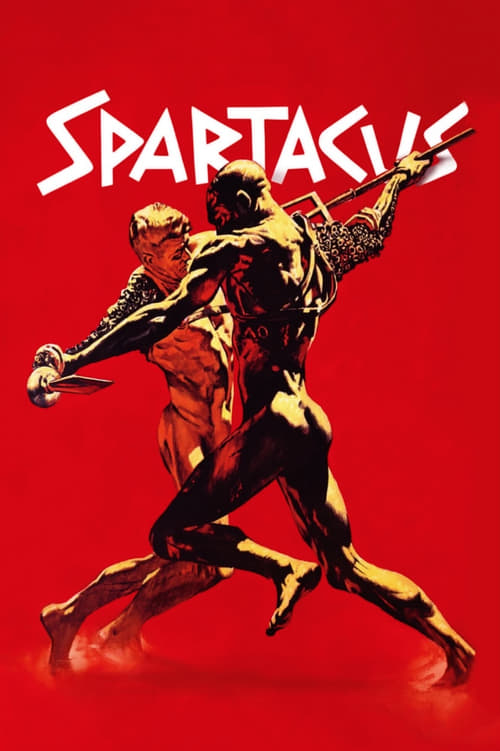
Spartacus (1960)
Genre
:
History | War | Drama | Adventure Rating
:
7.548 / 10
Release Date
:
13 October 1960 Resolution
:
1920x1080
Duration
:
3 : 17 minutes
Spoken Language
:
English Status
:
Released Overview
:
The rebellious Thracian Spartacus, born and raised a slave, is sold to Gladiator trainer Batiatus. After weeks of being trained to kill for the arena, Spartacus turns on his owners and leads the other slaves in rebellion. As the rebels move from town to town, their numbers swell as escaped slaves join their ranks. Under the leadership of Spartacus, they make their way to southern Italy, where they will cross the sea and return to their homes.
Cast Overview :

Spartacus
by: Kirk Douglas

Marcus Licinius Crassus
by: Laurence Olivier

Varinia
by: Jean Simmons

Sempronius Gracchus
by: Charles Laughton

Lentulus Batiatus
by: Peter Ustinov

Julius Caesar
by: John Gavin

Antoninus
by: Tony Curtis

Helena Glabrus
by: Nina Foch

Crixus
by: John Ireland

Tigranes Levantus
by: Herbert Lom

Marcus Publius Glabrus
by: John Dall

Draba
by: Woody Strode

David
by: Harold J. Stone

Marcellus
by: Charles McGraw

Claudia Marius
by: Joanna Barnes

Ramon
by: Peter Brocco

Gannicus
by: Paul Lambert

Guard captain
by: Robert J. Wilke

Dionysius
by: Nick Dennis

Caius
by: John Hoyt

Laelius
by: Frederick Worlock

Gladiator (uncredited)
by: Paul Baxley

Gladiator (uncredited)
by: Louie Elias

Gladiator (uncredited)
by: Brad Harris

Gladiator (uncredited)
by: Hubie Kerns

Gladiator (uncredited)
by: Gordon Mitchell
Gladiator (uncredited)
by: Regis Parton
Gladiator (uncredited)
by: Victor Paul

Gladiator (uncredited)
by: Jack Perkins
Gladiator (uncredited)
by: Wally Rose
Gladiator (uncredited)
by: Aaron Saxon
Gladiator (uncredited)
by: Tom Steele
Gladiator (uncredited)
by: Jerry Summers

Little Girl (uncredited)
by: Shari Lee Bernath

Prisoner (uncredited)
by: Bill Blackburn

Slave (uncredited)
by: David Bond

Slave (uncredited)
by: Polly Burson
Slave Girl (uncredited)
by: Carol Daniels
Slave (uncredited)
by: Lila Finn

Slave (uncredited)
by: Harold Goodwin
Slave Leader (uncredited)
by: Sol Gorss

Slave (uncredited)
by: Betty Harford
Slave (uncredited)
by: Harry Harvey Jr.

Slave Guard (uncredited)
by: Wayne Heffley
Slave (uncredited)
by: Lars Hensen
Slave Leader (uncredited)
by: Charles Horvath

Slave (uncredited)
by: Shep Houghton
Slave (uncredited)
by: Pete Kellett
Slave (uncredited)
by: Joan McKellen

Slave (uncredited)
by: Eddie Parker
Slave Leader (uncredited)
by: Gil Perkins

Slave (uncredited)
by: Chuck Roberson
Slave (uncredited)
by: Frosty Royce
Slave Girl (uncredited)
by: Autumn Russell

Slave (uncredited)
by: Kay Stewart
Slave Girl (uncredited)
by: Kay Stewart
Slave (uncredited)
by: Helen Thurston

Slave at Gracchus' Home (uncredited)
by: Louise Vincent
Soldier (uncredited)
by: Joe Canutt
Soldier (uncredited)
by: Bill Catching

Soldier (uncredited)
by: Chuck Courtney
Soldier (uncredited)
by: Chuck Hayward

Soldier (uncredited)
by: Robert F. Hoy
Soldier (uncredited)
by: Valley Keene

Soldier (uncredited)
by: Cliff Lyons

Soldier Whose Arm is Hacked Off (uncredited)
by: Bill Raisch

Soldier (uncredited)
by: Buddy Van Horn
Soldier (uncredited)
by: Jack Williams

Fimbria (uncredited)
by: Paul E. Burns
Guard (uncredited)
by: Wayne Burson
Guard (uncredited)
by: Dick Crockett
Capua Guard (uncredited)
by: John Daheim

Guard (uncredited)
by: Carey Loftin

Guard (uncredited)
by: Harvey Parry
Guard (uncredited)
by: Ronnie Rondell Jr.
Guard (uncredited)
by: Don Turner

Guard (uncredited)
by: Peter Virgo
Guard (uncredited)
by: Fred Zendar

Legionnaire (uncredited)
by: Ted de Corsia

Majordomo (uncredited)
by: Terence de Marney

Beheaded Man (uncredited)
by: Johnny Duncan

Roman Businessman (uncredited)
by: Roy Engel
Roman Businessman (uncredited)
by: Paul Keast

Roman Senator (uncredited)
by: Kenner G. Kemp

Roman Senator (uncredited)
by: Paul Kruger
Roman General (uncredited)
by: Otto Malde

Roman Senator (uncredited)
by: Scott Seaton

Salt Mine Slave / Gladiator / Slave General (uncredited)
by: Richard Farnsworth
Centurion (uncredited)
by: Logan Field

Centurion (uncredited)
by: John Stephenson

Extra (uncredited)
by: Robert Fuller

Woman Selling Chestnuts (uncredited)
by: Jeanne Gerson

Pirate (uncredited)
by: Seamon Glass
Pirate (uncredited)
by: Preston Peterson
Pirate (uncredited)
by: George Robotham

Otho (uncredited)
by: James Griffith

Petitioner (uncredited)
by: Jack Grinnage

Petitioner (uncredited)
by: Anthony Jochim

Marius (uncredited)
by: Joe Haworth

Metallius (uncredited)
by: Vinton Hayworth

Salt Mine Slave / Gladiator / Slave General (uncredited)
by: Loren Janes

Julia (uncredited)
by: Jil Jarmyn

Crassus' Standard-Bearer (uncredited)
by: Aron Kincaid

Symmachus (uncredited)
by: Dayton Lummis

Galeno (uncredited)
by: Bob Morgan

Girl (uncredited)
by: Tracy Olsen

Garrison Officer (uncredited)
by: Leonard Penn

Narrator (voice) (uncredited)
by: Vic Perrin

Staff Officer (uncredited)
by: Larry Thor

Trainer (uncredited)
by: Dale Van Sickel

Herald (uncredited)
by: Carleton Young
Roman Senator (uncredited)
by: Duke Fishman
Legionnaire (uncredited)
by: Robert Stevenson
Slave (uncredited)
by: John Barton
Soldier (uncredited)
by: Jerry Brown

Guard (uncredited)
by: John Benson

Legionnaire (uncredited)
by: Arthur Batanides
Soldier (uncredited)
by: Rudy Germane
Member Reviews :
The sword and sandal epic that has everything.
Spartacus is the Thracian slave who refused to be a Roman plaything, breaking out of their clutches he led the slave revolt that panicked the Roman Rebublic in circa BC 73, this film is based on that period in history.
Spartacus got off to a troubled start, original director Anthony Mann was fired by leading man Kirk Douglas (Spartacus) after a falling out, some of Mann's work does remain in the final picture, though, notably some of the early scenes in the desert are thought to be at Mann's direction. In came then director for hire Stanley Kubrick, who along with Douglas crafted arguably the greatest sword and sandal epic to have ever been made. One that holds up today as the one any prospective new viewers to the genre should seek out. Adapted by Dalton Trumbo from Howard Fast's novel (whilst also tapping from Arthur Koestler's novel, The Gladiators), Spartacus is a stirring experience highlighting the power of unity when faced in opposition to a tyrannical force. It's also boasting a number of intelligent and firmly engaging strands that are a credit to the excellent writing from the once blacklisted Trumbo. Politics figure prominently, whilst the story has a pulsing romantic heart beating amongst the blood and power struggles that are unfolding. Brotherhood bonds within the slave army are firmly established, and the love story axis between Spartacus and Varinia is very fully formed. We are in short set up perfectly for when the film shifts the emphasis in the second half.
So many great sequences are in this picture, the gladiator training school as Spartacus and his fellow slaves find that they have dignity within themselves - forced through a tough regime designed to set them up for blood sport entertainment to the watching republic hierarchy. The break out itself is tremendous for its potency, but even that is playing second fiddle to the main battle sequence that Kubrick excellently puts together. The Roman legions forming in military precision is memorable in the extreme (this before CGI, with Kubrick's directing of all those extras being worthy of extra praise from us). Then with the battle itself raging one can only say it's breath taking and definitely a genre high point. Then of course there is the sentimental aspects of Spartacus. Kubrick of course was never known for his warmness, but with the aid of Douglas they get it right and manage to pull the heart strings whilst simultaneously stirring the blood via the action, right up to the incredibly poignant and classical ending that stands the test of time as being cinematic gold. The cast are wonderfully put together, Douglas is fabulous as Spartacus, big, lean and brooding with emotion, very much a career highlight as far as I'm concerned. Laurence Olivier takes up chief bad guy villainy duties as Marcus Crassus, just about the right amount of sneering camp required for such a dislikable character. Peter Ustinov (Best Supporting Actor Winner) is in his pomp as Batiatus, Jean Simmons (perfectly bone structured face) plays off Douglas expertly as Varinia, with Tony Curtis (Antoninus), John Gavin (Julius Caesar) and Charles Laughton (Graccus) adding impetus to this wonderful picture.
Spartacus also won Academy Awards for Best Colour Cinematography, Best Art and Set Direction and Best Costume Design, with nominations rightly going to Alex North for his score and Robert Lawrence for his editing. It's a special film is Spartacus, excellently put together and thematically dynamite. Which while also being technically adroit, it's ultimately with the story itself that it truly wins out. Even allowing for some standard Hollywood additions to the real story (Spartacus most certainly didn't meet his maker the way the film says), it's emotionally charged and as inspiring as it is as sadly tragic. 10/10
This historical/epic drama was one of those 50-60's movies that lasted for 3 and a half hours. It isn't perfect despite the production have being great in some points.
The main issue is that it isn't historical based (and who knows the history to the full extend?), but it was based on a Roward Fast novel of 1951 with lots of romanticized and non historical events.
Some things are history: like the basis of the dispute of the senate member involved in the rebellion, like Crassus (the main opositor), Grassus (the roman senator that was more a patrician than a warrior) and young Julius Cesar.
Played by Kirk Douglas, Spartacus was a Thracian man enslaved to work on the sulfur mines of Etna (that seems to be the same place that Barravas was filmed). Due to his rough and tempestuous humor, the is set to die by starvation - but his fierceness attracts a roman busniness man that trains gladiators. He start and training, getting better and better at this.
Eventually he is introduced to the Britannia woman Varinia that the slavemaster gives to his gladiators' and starts to fell in love with her. After a visit of Crassus his wife (that just vanish from the movie after that) wants a dispute between 4 gladiators, just for entertainments - at the time they weren't cheap. They took years of training and investment, and historically they seldom fighted to the death, they usually were just killing machines for spectacles at the areas or killing of prisoners.
While his friend wins a fight and kills the opponent, spartacus fights bravely but loses to an Ethiopian gladiator named Draba that doesn't tries to kill after winning and jump for the spectators. This changes Spartacus views for everything.
He plans a scape with other slaves and just using kitchen tools they made a escape overriding the romans soldiers at the place and stealing their weapons, starting a slave revolt that rise moree and more though the villages and cities they pass by, till they camp at the side of the Vesuvius.
At this point the situation is a vexation to Rome's senate, that have a lesser guarnition of soldiers, with the majority in campaign on the east (india) and west (Iberia). Evry try to contain the rebellion fails.
Spartacus doesn't plan to take Rome or anything he just want freedom for him and his companions - so he bribe a circician pirate (Circicia was a place in modern day anatolian peninsula, at Turkey) to bring 5 ships to all be left from a port in the south of Italy.
Learing of this plans Grassus that was a fierce opponent of Crassus at the senate bribe the pirate to undone the deal, and tries to convince young senator Julius Cesar to attack Spartacus. He by his turn doesn't like this sort of low move and tells Crassus about the plans.
By this time the Iberian regiment is back and Spartacus doesnt much what to do other than fight to his life and try to do a rebellion at the capital, so a major battle is set to occur.
The movie has several weak points - instead of basing of what history told us and try to do an alternative historic end, in the romance of Roward Fast of 1951 he puts inconsistences of time, and characters that doesn't exists. The book was transformed in a screenplay by Dalton Trumbo (blacklisted by Hollywood by be part of the communist party in the Cold War Era).
The direction of the movie was to be by Anthony Mann that quitted seeing the scope and difficulty of the movie, thn it handled down to the young Kubrick that already filmed "Paths of Glory". Kubrick talent was recognized as well as his excenties and ways of working especially on the takes. This time he had budget of $12 million (equivalent to about $120 million in today's funds - and a return of 17 million) and a cast of 10,500 extras to work with.
For instance the had troubles with the veteran cinematographer Russell Metty, because Kubrick wanted the use of a 35-mm Super 70 Technirama format blown up to 70 mm film, since Kubrick preferred using the standard spherical format, that allowed him to achieve ultra-high definition and to capture large panoramic scenes.
Kubrick also had wanted to shoot the picture in Rome with cheap extras and resources, but Edward Muhl, president of Universal Pictures, wanted to make an example of the film and prove that a successful epic could be made in Hollywood itself - this made the scenes at Rome and other to look cheap with the painted background.
But the open scenes was another thing: just no short of espetacular due to the vastness of scenarios and number of extras. For example the battle used around Madrid 9,000 Spain infantry men to make the roman empire legions at move, filmed though a tower. The cries of "Hail, Crassus!" and " I'm Spartacus!" were recorded at a Stadium in a game with 76,000 expectators. No doubt this influenced "I'm Sparta!" from "300" on the 90´s.
The final battle scene is notoriously the best part of the movie that had for the most tedious parts and dialogues, not helped with the stylish 50-60´s orchestral Hollywood leitmotif technique by Alex North that even used ancient instruments o make the musics. At least for me the music were common place among all others of the era.
On the final battle (there were three battles in this revolt), most of the scenes had to be cut due to a negative reaction on a test screening due to the violence - scenes like the disremembering of an arm with gushing blood shows what we may had missed.
In the end, the movie tries to reach epic proportions hard to be reachable with the weak screenplay and producers (Edward Lewis). With the right producer and a better screenplay and music it could have been an true epic (as he just glimpsed what Kubrick could do if he had the command of the project).
To this day I still a true rendition of Spartacus and not a series for TV. At least the movie inspired Ridley Scott to make one of my favorite movies on the genre to this day, "Gladiator". But one scene that is maked in my mind on this one is before the fatidical last battle Spartacus walking thought the slaves camp seeing couples, families fiends and a old couple braced together, knowing of their fate and feeling the weight of his task ahead (juts a not: nobody knows the whereabouts of the real Spartacus he was never identified on the battlefield and nobody know what happened to him).
In the end the film won four Academy Awards (Best Supporting Actor for Ustinov, Best Cinematography, Best Art Direction and Best Costume Design) from six nominations, and was a success (the standards for revenue return were different at that time)
I gave half an extra star and a favorite for Kubrick's courage on this movie, that would be way better. My score for it is 7,0 out of 10,0 a B.
Version watched: Criterion 2015 4K restoration based on 91s restauration of the original movie.
Kirk Douglas had the vision to back the previously black-listed Dalton Trumbo with his excellent screenplay for this epic tale of slavery and the struggle for freedom. He also led a cast with some of the best actors to ever grace the silver screen. Olivier, Laughton, Ustinov, Curtis and a wonderfully tender Jean Simmons who all lift this tale of a slave who rebelled against the tyrannical rule of his Roman masters and inspired thousands to follow him as they strove to escape, then defeat the armies of Rome. The cinematography, colour, costumes are all the stuff of artists and Alex North creates a score that carries the intimate and the grand scenes in equal measure. The principles of struggle against oppression and of brotherly loyalty ring true even now, and this film is so much more than a sword-and-sandals melodrama.