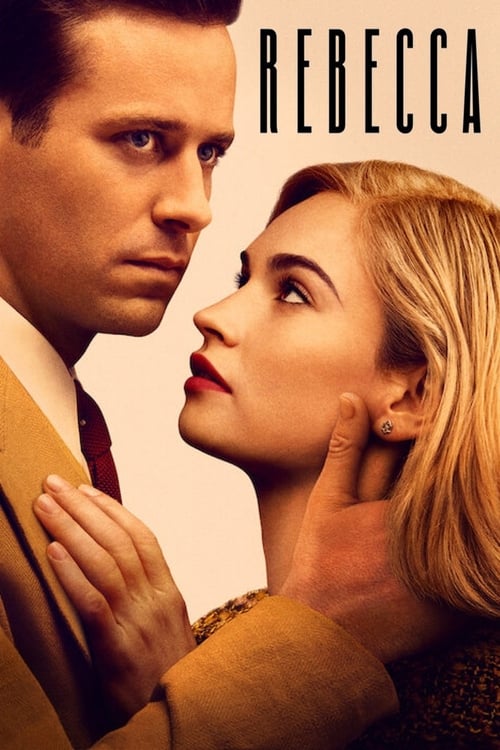
Rebecca (2020)
Genre
:
Romance | Drama | Mystery | Thriller Rating
:
6.3 / 10
Release Date
:
16 October 2020 Resolution
:
1920x1080
Duration
:
2 : 3 minutes
Spoken Language
:
English, Français Status
:
Released Overview
:
After a whirlwind romance with a wealthy widower, a naïve bride moves to his family estate but can't escape the haunting shadow of his late wife.
Cast Overview :

Mrs. de Winter
by: Lily James

Maxim de Winter
by: Armie Hammer

Mrs. Danvers
by: Kristin Scott Thomas

Beatrice
by: Keeley Hawes

Mrs. Van Hopper
by: Ann Dowd

Jack Favell
by: Sam Riley

Frank Crawley
by: Tom Goodman-Hill

Inspector Welch
by: Mark Lewis Jones

Giles
by: John Hollingworth

Dr. Baker
by: Bill Paterson

Taxi Driver
by: Jacques Bouanich

Guest With Dog
by: Marie Collins

Restaurant Maitre D'
by: Jean Dell

Restaurant Guest
by: Sophie Payan

Mrs. Jean Cabot
by: Pippa Winslow

Mrs. Clementine Whitney
by: Lucy Russell

Terrace Maitre D'
by: Bruno Paviot

Terrace Waiter
by: Stefo Linard

Hotel Bellhop
by: Tom Hudson

Frith
by: Jeff Rawle

Robert
by: Ashleigh Reynolds

Clarice
by: Bryony Miller

Ben
by: Ben Crompton

Granny
by: Jane Lapotaire

Phillippa
by: Poppy Allen-Quarmby

Lord Crowan
by: David Cann

Lady Crowan
by: Julia Deakin

Kitchen Folk Singer
by: Jason Williamson

Ben's Father
by: Colin Bennett
Scullery Maid
by: Jess Irvin Rose
Manderley Villager
by: Chris Bearne

Manderley Villager
by: John MacNeill
Reporter
by: Harry Gostelow

Reporter
by: Robert Irons

Coroner
by: David Horovitch
Sargent Rowe
by: Steven Waters
Night Watchman
by: David Appleton

Manderley Ball Guest
by: Adam Burton

Manderley Ball Guest
by: Fionn Cox-Davies

Manderley Ball Guest
by: Sonya Cullingford
Manderley Ball Guest
by: Kirsty Arnold
Manderley Ball Guest
by: Alistair Goldsmith
Manderley Ball Guest
by: Omari Gordon
Manderley Ball Guest
by: Fania Grigoriou

Manderley Ball Guest
by: Jane Leaney
Manderley Ball Guest
by: Miranda Letten
Manderley Ball Guest
by: Connor Scott
Manderley Ball Musician - Drums
by: Nicholas Ball
Manderley Ball Musician - Trumpet
by: Evan Clegg
Manderley Ball Musician - Violin
by: Phillip Granell
Manderley Ball Musician - Trombone
by: Daniel Hewson
Manderley Ball Musician - Guitar
by: Matthew Redman
Manderley Ball Musician - Clarinet
by: George Sleightholme
Manderley Ball Musician - Accordion
by: Romano Vizzani
Manderley Ball Musician - Accordion
by: Ian Watson

Villager (uncredited)
by: Stuart Davidson
Stable Boy (uncredited)
by: Julian Ferro

Coroner's Policeman (uncredited)
by: Toby Sauerback
Member Reviews :
If you enjoy reading my Spoiler-Free reviews, please follow my blog @
https://www.msbreviews.com
Netflix’s Rebecca is based on the 1938’s novel of the same name written by Daphne du Maurier, but it’s not its first cinematic adaptation, which leads me to the following shameful statement: I’ve never seen the famous Alfred Hitchcock’s version of this story (nor have I read the novel, but I firmly defend that this doesn’t matter). It’s the only film of Hitchcock’s filmography to have received the Best Picture award, so I admit that I’m much at fault here. However, Ben Wheatley isn’t directing a remake of the original movie, but rather another adaptation of the also incredibly popular novel. I was intrigued by the premise, and the cast is definitely convincing, so how did it go?
If I had to choose one word to ultimately describe Rebecca right now, it would probably be… weird. More on this in a bit. Starting with the positives, Armie Hammer and Lily James share such vivid chemistry that it elevates the surprisingly compelling bond that their characters form. I write “surprisingly” because I’m not easily engaged in most romantic relationships in films, whether these are straight-up romances or mixed up with other genres, like comedy or, as in this case, horror/thriller. Nevertheless, Lily and Armie are able to capture perfectly the growing love interest in one another through the first act, which is entirely dedicated to develop and nurture the key relationship of the movie.
This is something I sincerely appreciate: when filmmakers know how to control pacing and how much time should a particular character or storyline receive of build-up. Wheatley does an impressive job during the first half of the film by moving the characters and plot forward at the precise moment they need to. This allows the viewer to understand what the characters are genuinely feeling and why some narrative decisions are made that change the course of the story. Lily James offers a remarkable performance, just like Armie Hammer. Kristin Scott Thomas is also excellent, even though her character is part of my problems with the movie. However, it’s the production design that stands out!
The beautiful colors and striking landscapes of the French Riviera fill the screen with luxury and harmony during the naturally passionate beginning of the relationship. Once the narrative moves to Manderley, the tone changes to a gradually more depressing, dark environment, accompanied by a creepy score (Clint Mansell), and spooky nightmares. The adequate costumes also help to set the atmosphere, but the beginning of the second half is where things start to get extremely weird.
From the very first moment the viewer sets place in Manderley, something is noticeably not right. Everyone addresses the late wife, Rebecca, as the most perfect human being to ever exist, reaching God-like compliments in a clear attempt of trying to create the cliche “previous wife was amazing, new one is awful, let’s make her life a living hell” storyline. An expected development with exaggeratedly positive comments from the staff. However, it’s the horror vibe that embraces the mansion that drives me nuts. Wheatley sets a dark, mysterious, even supernatural environment surrounding the house, a definitely intriguing aspect that leads to a hugely disappointing, hollow, unsatisfactory conclusion.
From the first to the second act, the genre in display changes from a fun, lighthearted romance to a horror/thriller featuring a “haunted” mansion. The tone change is far from being smooth. However, the third act stores a drastic shift in pretty much everything: tone, genre, story, and even characters. I can’t get into details, but it’s the most incomprehensible decision in the entire film. The last act not only follows a path that comes from nowhere, but it’s also incredibly rushed, concluding the movie in the most disjointed, convoluted way possible.
It raises questions related to events and characters in the previous act, it treats Mrs. Danvers very poorly, and ends with a deceiving last shot that makes the viewer think “did I miss something?” when the answer is a clear “no, it’s just a weird ending”. Clint Mansell’s score is captivating, but its timing is just completely off. It’s this feeling of false uncertainty that leaves me frustrated. Why try to make a film about something that it’s not? Why try to give Rebecca a horror vibe if it doesn’t lead to any impactful outcome? I finished the movie with doubts that have no reason to exist simply because the question should have never been asked by the story in the first place...
All in all, Netflix’s version of Rebecca gets lost in trying to balance so many genres in just one film. Ben Wheatley does a great job controlling the pacing, offering enough time to develop the main characters and the core relationship. However, the tone changes are far from being well-executed, leading to an utterly absurd, rushed, convoluted last act out of nowhere that raises logical questions and leaves the viewer with a false sense of uncertainty. A well-structured, entertaining first half partially compensates for the weirdness that overflows the second part. Lily James and Armie Hammer deliver great performances, as does Kristin Scott Thomas, but the production design (supported by terrific costumes) steals the spotlight. Clint Mansell’s score doesn’t go unnoticed, but its placement is exceptionally inefficient. In the end, the attempt at creating a horror atmosphere with the “haunted” mansion storyline is so anti-climactic that I can’t wholeheartedly recommend this flick…
Rating: C
Splendid Remake!
At the start, Wheatley’s direction sails us around an elegant coastal hotel in this lavish period drama. With enviable period fashion and classic cars, a wicked, obtrusive employer is easily replaced by a quietly confident Maxim, handsomely and splendidly played by Mr. Hammer. How lucky is the beautiful (yet daunted) lady’s companion to have met him. Or is shi?
Mr. Hammer’s Maxim is not cocky or patronizing as Mr. Olivier’s in 1940; Mr. Hammer is quite appealing at the start. Miss James offers as brilliant a performance as Joan Fontaine’s in 1940. I also prefer this pleasant and proper 2020 version (instead of the 1940 version). I expect as much from the British and from the ‘lady and gentleman’ dance of the director (Wheatley) and the screenwriters (Goldman, Shrapnel, Waterhouse).
All the characters have depth; some have brooding; Hammer and James’ characters develop nicely throughout; and the cinematography and music were compelling. While watching this remake, I gladly no longer cared about the book or the original film. I think there should have been award nominations, too. How I envy the love some have to “walk through flames for ..”