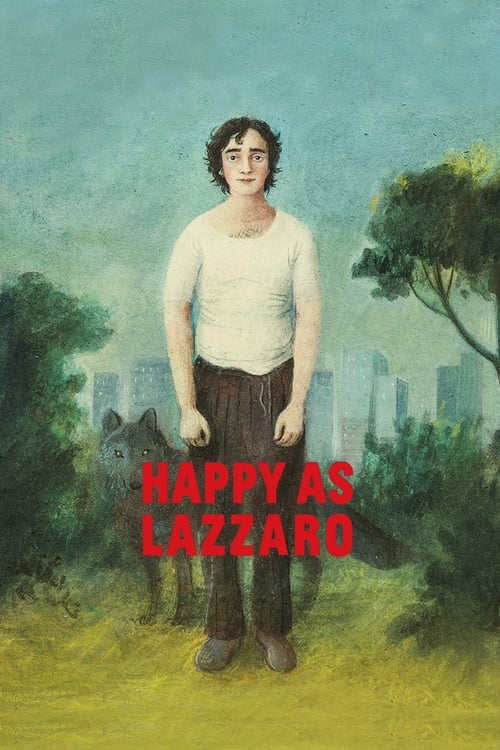
Happy as Lazzaro (2018)
Genre
:
Drama | Fantasy Rating
:
7.4 / 10
Release Date
:
31 May 2018 Resolution
:
1920x1080
Duration
:
2 : 8 minutes
Spoken Language
:
Italiano Status
:
Released Overview
:
Purehearted teen Lazzaro is content living as a sharecropper in rural Italy, but an unlikely friendship with the marquise’s son will change his world.
Cast Overview :

Lazzaro
by: Adriano Tardiolo

Antonia (young)
by: Agnese Graziani

Tancredi (young)
by: Luke Chikovani

Antonia
by: Alba Rohrwacher

Ultimo
by: Sergi López

Tancredi
by: Tommaso Ragno

Nicola
by: Natalino Balasso

Marchesa Alfonsina De Luna
by: Nicoletta Braschi

Pippo
by: Carlo Massimino
Maria Grazia (Adult)
by: Daria Pascal Attolini
Stefania
by: Maddalena Baiocco
Teresa
by: Giulia Caccavello
Natalina anziana
by: Annunziata Capretto

Maresciallo
by: Alessandro Genovesi
Appuntato
by: Davide Denci
Pippo (young)
by: Edoardo Montalto

by: Leonardo Nigro

Stefania
by: Gala Othero Winter
Natalina (adult)
by: Iris Pulvano
Maresciallo
by: Ettore Scarpa
Suora
by: Pasqualina Scuncia
Carletto
by: Carlo Tarmati
Head animal trainer
by: Pascal Tréguy
Donna Truffata
by: Daria Deflorian

Teresa (adult)
by: Elisabetta Rocchetti

Catirre adulto
by: Luciano Vergaro
Catirre anziano
by: Annibale De Luca
Ardito adulto
by: Giuseppe Corsini
Ardito anziano
by: Marcello Duranti
Don Severino
by: Marco Donno
Giuseppe
by: Nicola Sorci
Mariagrazia
by: Sofia Stangherlin
Mariù (young)
by: Silvia Lucarini
Mariù (adult)
by: Cinzia de Luca
Grandmother Agostina
by: Lucia Centoscudi
Assuntina
by: Anita Crucitti

Swiss engineer
by: David Bennent

Nicola anziano
by: Antonio Salines
Member Reviews :
‘Happy as Lazzaro’ comes and goes like an airy fable but doesn’t make as much of an impact as it wants to. Through a lack of convincing and earned pivot, its first half in realism drags down the escapism it yearns for in its second half. Its ambition is to be commended and is definitely a film that deserves to be seen, but as a whole is just verging on greatness.
- Ashley Teresa
Read Ashley's full article...
https://www.maketheswitch.com.au/article/review-happy-as-lazzaro-more-than-meets-the-eye
A tale (or fable?) of social commentary by directress and writer Alice Rohrwacher (that I first knew in the short "Le Pupille") in rural Italy with touches of anti capitalism and class division, where sharecroppers live, without knowing their semi-slavery state because of lack of knowledge. Lazzaro the protagonist, is an innocent character that is happy to make others happy, in the pureness of his heart. He doesn't know who is his father of mother just who is maybe his grandmother.
There are very few signs of when this passes you can guess the 60 or 70's till later you see a cellphone of the 90's. So this is the condition that those people lives.
They live under Marchesa Alfonsina De Luna state till one day Lazzaro meets the rebellious son of her, Tancredi, that wants to live away from the rot of his bankrupt family, so he devise a plan.
A plan that unwillingly ends ends with and event that throws Lazzaro in the future 20 to 30 years ahead. By chance or destiny he meet robbers in the now decadent rural mansion (not knowing that they are people of his past "family") and in the city where he is recognized by an old female friend (the role is played by the older sister of Rohrwacher, Alba) - the only one that sees the miracle of him not ageing anything at all (and not all broken and bloody by the event that happened so many years ago, not seen by anyone).
In this urban future he ends up living within the same ignorant and individualist clan (with some exceptions) and ends up meeting by chance the Baroness son again, decadent as ever in his dreams of richness that broke his spirit.
Not telling the end after all this spoilers, but it is sad to see Lazzaro so pure treated as nothing, unhappy by his friend status, and trying to correct things in a wrong way in his innocency (no, it doesn't have an happy ending).
A movie that may not be for everyone but that shines to see such saintness and pureness of heart among our society.
Good cinematography and choice of colors, with Kodak Super 16mm film by cinematographer DP Hélène Louvart AFC and good acting by the protagonist, the newcomer Adriano Tardiolo.
I would score this one a 8.0 out of 10.0 / A-.
Adriano Tardiolo is really good in this biblically apt story of the young “Lazzaro”. He’s a generous-spirited young man who energetically helps out in his community - one under the thumb of the uncaring dominatrix “Marchesa” (Nicoletta Braschi) who treats this agrarian community little better than the animals she describes them as. She has a teenage son “Tancredi” (Luca Chikovani) who, though spoiled, has a bit of a rebellious streak and so when he befriends “Lazzaro” and discovers the young man’s hilltop hideaway, he decides to abscond from his mother and feign a kidnapping. Perhaps unsurprisingly, his mother sees through his wheeze and declines to pay up the ransom but that stalling has the benefit of allowing these two young men to establish what they hope will be an indelible friendship. Then “Lazzaro” takes a bit of a tumble and when he awakens, nothing is as it was. For all but him, decades have gone by and it’s only a chance encounter with childhood friend “Antonia” (Agnese Graziani) and her family of somewhat understandably sceptical scrap merchants and petty thieves that offers him a chance of a new life in the city. He is shy and honest so doesn’t readily fit into their community but she won’t allow them throw him onto the streets even if she reckons he’s pretty useless, too. It’s pretty clear to everyone that all he really wants is to find his friend - but what chance now? This mixes a culture of cruel, venal, exploitation with a delicate religiosity and that turns out to be quite a poignant combination as events unravel in the latter part of the film. Tardiolo hasn’t a great deal of dialogue, indeed there isn’t really that much here at all, and that works well. It’s presented as something akin to parables concerning kindness, do unto others, reap what you sow kind of thing, before a denouement that is both ghastly and yet somehow affirmatively symbolic. What does it mean to be human in a sense of humanity rather than chemical engineering? What does set us apart from the animals? Superstition, faith, love, fear, music, decency? Lots of questions posed amongst the simplicity here and it’s delicately delivered and engagingly thought-provoking at times.