Last Year at Marienbad (1961)
Genre
:
Drama | Romance Rating
:
7.4 / 10
Release Date
:
25 May 1961 Resolution
:
1920x1080
Duration
:
1 : 35 minutes
Spoken Language
:
Français Status
:
Released Overview
:
In a strange and isolated chateau, a man becomes acquainted with a woman and insists that they have met before.
Cast Overview :

A – The Brunette Woman
by: Delphine Seyrig

X – The man with the Italian Accent
by: Giorgio Albertazzi

M – The Other Man with the Lean Face, The Husband
by: Sacha Pitoëff

A Character from the Hotel
by: Françoise Bertin

A Character from the Hotel
by: Luce Garcia-Ville
A Character from the Hotel
by: Héléna Kornel

A Character from the Hotel
by: Françoise Spira
A Character from the Hotel
by: Karin Toche-Mittler

A Character from the Hotel
by: Pierre Barbaud
A Character from the Hotel
by: Wilhelm von Deek

A Character from the Hotel
by: Jean Lanier
A Character from the Hotel
by: Gérard Lorin
A Character from the Hotel
by: Davide Montemurri
A Character from the Hotel
by: Gilles Quéant
A Character from the Hotel
by: Gabriel Werner
Member Reviews :
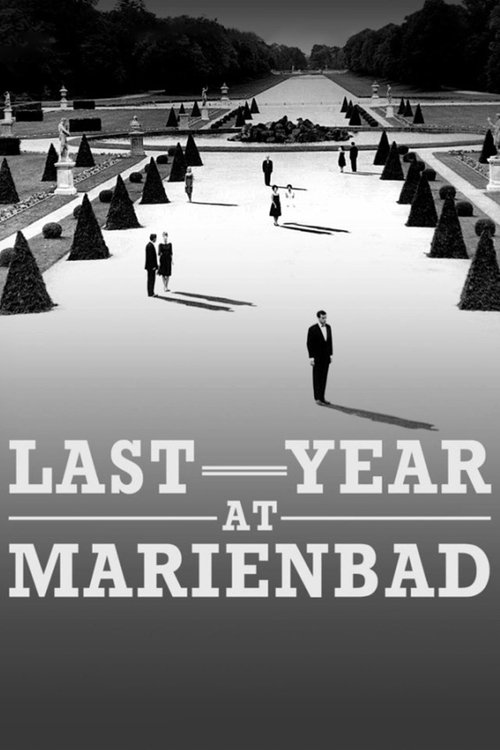
There's something almost ethereal about this film. Set amidst the palatial splendour of a luxury hotel, a group of unnamed residents are gathered for a sophisticated weekend. There's an instant chemistry between the lady (Delphine Seyrig) and the gentleman (Dacha Pitoëff) with the latter trying to assure the former that this isn't the first time they have met. She has no recollection of any previous encounter, and so with the help of a gentle narration from Giorgio Albertazzi we watch as he attempts to convince her before their time in the château runs out. There's not a great deal of dialogue to support the story here, it is largely down to the gloriously photographed monochrome imagery as the two perform a sort of dance with each other. The tempo of that dance seems to depend on her mood more than his. At times she seems to want to be convinced, at others she seems determined to spurn him - however delicately. His frustrations, tempered with strong feelings of love, are constantly pushing him but the sterility of his environment seems to constrain him. The house itself is huge with never ending corridors lined with mirrors and statues. The grounds entirely consist of gravel as if it were a desert island surrounded by aridity. He is encouraged by the other guests to play games - with cards, or matches, but these games seem impossible for him to win - even when he does seem to grasp the simplicity of the rules. The whole place appears designed to tantalise, tease and tempt - but is anyone there ever going to get what they want? Filmed around various German grand palaces, and featuring the astonishing Spiegelsaal of mirrors, these huge great spaces make the people seem like little more than occupying, and cold, insects and I felt like one of them too as a certain empty inevitability crept into the proceedings. There's not a great deal going on, so don't expect much in the way of pace or development - it's just a thing of beauty to watch on a big screen with a potent score from Francis Seyrig to top it off. Is this all destined to happen again next year?
One of the masterpieces of the French Golden Age of cinema. Far too complex for audiences accustomed to a simple, linear narrative moving from A to B through character development, conflict, and resolution. If that is the kind of film you enjoy, this may not be for you.
The film presents a series of fragmented narratives involving nameless characters wandering through a magnificent baroque château. On the surface, it appears to be a love story, although "story" may not be the correct word. Events cannot be arranged with certainty into a chronological sequence.
Resnais does not tell a story in the conventional sense. Instead, he describes one through the juxtaposition of images, memories, repetitions, associations, and recurring motifs. The experience resembles a dream that keeps rewriting itself while remaining strangely familiar.
The film's influence can be seen in the work of directors such as Stanley Kubrick and David Lynch. More than sixty years later, it remains one of cinema's most fascinating explorations of memory and perception.
A masterpiece and essential viewing for anyone interested in film as an artistic language rather than merely a vehicle for storytelling.