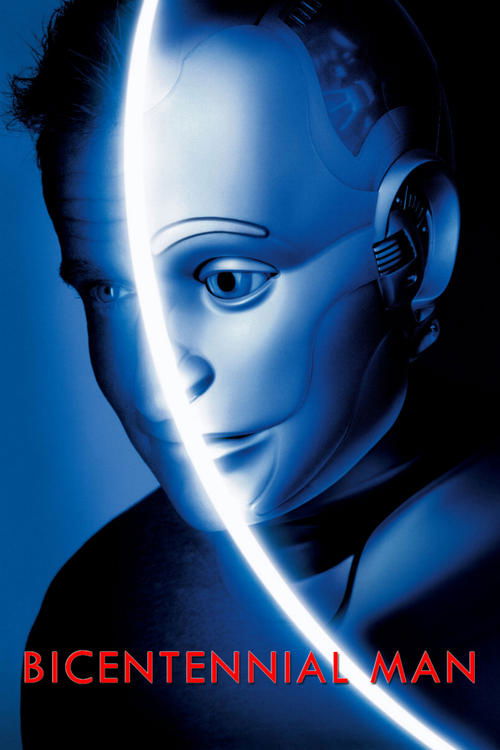
Bicentennial Man (1999)
Genre
:
Science Fiction | Drama Rating
:
7.263 / 10
Release Date
:
17 December 1999 Resolution
:
1920x1080
Duration
:
2 : 11 minutes
Spoken Language
:
English Status
:
Released Overview
:
Richard Martin buys a gift, a new NDR-114 robot. The product is named Andrew by the youngest of the family's children. "Bicentennial Man" follows the life and times of Andrew, a robot purchased as a household appliance programmed to perform menial tasks. As Andrew begins to experience emotions and creative thought, the Martin family soon discovers they don't have an ordinary robot.
Cast Overview :

Andrew
by: Robin Williams

Little Miss / Portia
by: Embeth Davidtz

Sir
by: Sam Neill

Rupert Burns
by: Oliver Platt

Galatea Robotic / Human
by: Kiersten Warren

Ma'am
by: Wendy Crewson

Little Miss 7 yrs. old
by: Hallie Eisenberg

Miss 9 yrs. old
by: Lindze Letherman

Miss
by: Angela Landis

Bill Feingold
by: John Michael Higgins

Lloyd
by: Bradley Whitford

Lloyd 10 yrs. old
by: Igor Hiller

Robot Delivery Man
by: Joe Bellan

Robot Delivery Man
by: Brett Wagner

Dennis Mansky
by: Stephen Root

Motorcycle Punk
by: Scott Waugh
Frank
by: Quinn Smith
Monica
by: Kristy Connelly

Charles
by: Jay Johnston

Male President
by: George D. Wallace

Female President
by: Lynne Thigpen
Zimbabwe Representative
by: Ples Griffin

Lloyd's Wife
by: Marcia Pizzo

Feingold's Assistant
by: Paula DuPré Pesmen

Priest
by: Clarke Devereux
Engagement Party Guest
by: Bruce Kenneth Wagner
Singer
by: Paula West
Restoration Worker #1
by: Kevin 'Tiny' Ancell
Restoration Worker #2
by: Richard Cross
Humanoid Head
by: Adam Bryant
Puppeteer
by: Eric Fiedler
Puppeteer
by: Billy Bryan
Puppeteer
by: Christopher Nelson
Puppeteer
by: Jim Kundig
Puppeteer
by: Terry Sandin

Puppeteer
by: Mike Elizalde

Puppeteer
by: Mark Garbarino
Puppeteer
by: Christian Ristow
Puppeteer
by: Leonard MacDonald
Puppeteer
by: Dan Rebett
Puppeteer
by: Bernhard Eichholz
Puppeteer
by: Evan Brainard

Puppeteer
by: Benny Buettner
Puppeteer
by: Kamela Portuges

Puppeteer
by: Michael Steffe
Puppeteer
by: Mark Walas
Member Reviews :
It's a bit of a linguistic faux-pas that gives their new android the name "Andrew" (Robin Williams) after it arrives at the home of "Sir" (Sam Neill), his wife (Wendy Crewson) and their two daughters. The younger of those is a little more engaged with this butler-cum-housekeeper but her sibling thinks it belongs on a scrapheap - sometimes with quite humorous results. As the family start to get used to their new gadget, though, they experience some surprising changes in attitudes and questions are raised about just what constitutes "humanity". He is sympathetic, creative, empathetic and those characteristics aren't wasted on the mother in whom he confides his desire for freedom. Isn't he happy? Why does he want to leave? Well "Sir" takes a bit of umbridge at this request but grants it - and so "Andrew" finds himself free to live his life as he sees fit whilst still remaining in contact with a family who are no less divided about him and his role than they were a generation (or two) ago. Meantime, he embarks on a quest to track down the other robots of his generation and that introduces him to scientist "Rupert" (Oliver Platt) who suggests that there are ways of changing his appearance to present an altogether more human appearance. This unnerves those of his human family but enables him to re-engage with the sceptical "Portia" (Embeth Davidtz) and so take his journey onto an whole new and emotional level. Williams always was good at crafting a character that could bring a tear from a glass eye, and aided by a solid Isaac Asimov story and a typically orchestral score from James Horner he manages to create a character in whom we could invest a little. Of course, some of it is just plain daft and as "Andrew" hits his bicentennial the societal environment in which he lives did seem totally unrealistic, but by that point it had stopped being a sci-fi story and become something more of a romance that I struggled a bit to believe in. It's essentially a story of evolution - human and technological, and it's also one that sets out clearly the potential for artificial intelligence to acquire the need for love and for the ability to give it too.
Too long. I understand the heart but we didn’t need to see twelve generations to get the point across.