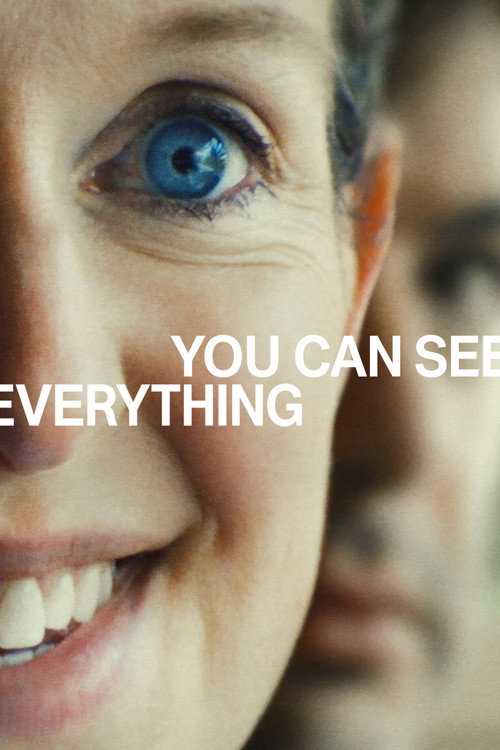
You Can See Everything (2026)
Genre
:
Documentary Rating
:
9.113 / 10
Release Date
:
16 October 2026 Resolution
:
1920x1080
Duration
:
2 : 54 minutes
Spoken Language
:
English Status
:
Released Overview
:
Thirty-four days before she's sent to prison, notorious Silicon Valley founder Elizabeth Holmes invites a skeptical film crew to document her every move. What begins as an intimate portrait of an enigmatic felon becomes a mind-bending three-year journey into the abyss.
Cast Overview :

Self
by: Elizabeth Holmes

Self
by: Nathan Fielder

Self
by: Billy Evans

Self / Elizabeth Holmes
by: Amanda Seyfried

Self / Billy Evans
by: Christopher Abbott

Self
by: Lance Oppenheim

Self
by: Christian Rasmus Holmes IV
Self
by: Noel Anne

A24 Executive
by: Gary Wilmes

A24 Executive
by: Phillip Andre Botello
Member Reviews :
*You Can See Everything* is genuinely tense and deceptively riveting. It takes the audience on a remarkable journey full of outrageous revelations, and yet the biggest secrets are never revealed.
https://bit.ly/YCSE
If you enjoy tidy documentaries that answer all questions and provide a definitive resolution—this isn’t the movie for you. *You Can See Everything* is an absorbing film that invites endless interpretation while remaining elusive about what, exactly, it wants to say. There is plenty to chew on here, and the film's greatest strength may also be its most significant weakness: it leaves so much unresolved that separating deliberate ambiguity from a lack of focus becomes a challenge in itself.
**Quick preface:** *You Can See Everything* assumes the audience is already familiar with the story of Elizabeth Holmes and Theranos. The Film Critics recommend HBO’s 2019 documentary [*The Inventor: Out for Blood in Silicon Valley*](https://thefilmcritics.org/movie-review/the-inventor-out-for-blood-in-silicon-valley/) to anyone unfamiliar with the backstory.
One thing *You Can See Everything* gets right is that Elizabeth Holmes remains a fascinating subject precisely because she is so difficult to read. The film raises questions that other documentaries and media treatments have barely touched, offering new angles on the person behind the notorious public persona. Rather than simply revisiting familiar territory, it opens up a broader conversation about sincerity, performance, identity, and the stories people tell about themselves. There is no shortage of material to debate, and viewers will likely emerge with very different interpretations of what they have witnessed.
The film's willingness to linger can also be surprisingly effective. Although its runtime is undeniably excessive at nearly three hours long, *You Can See Everything* is rarely dull in the conventional sense. Its unfolding narrative has a peculiar gravitational pull, drawing the audience deeper into its subject's world even when the destination remains unclear. Some scenes feel remarkably raw and unguarded, as though the camera has simply been allowed to sit in the room rather than orchestrate a moment for public consumption. That intimacy lends the documentary an unpredictable energy, making it difficult to dismiss as mere sensationalism.
One particularly revealing scene involving a classic comedy sketch offers a very telling glimpse into Holmes's psychology. It is the kind of sequence that invites close examination, suggesting layers of meaning without spelling them out. Such moments demonstrate how compelling the documentary can be when it trusts the audience to read between the lines, while also highlighting the opportunities it leaves unexplored.
The trouble is that the film can sometimes mistake prolonged observation for meaningful revelation. There are stretches when the viewer cannot help wondering whether or not the documentary is taking the scenic route to get to a point. The accumulated footage sometimes feels voyeuristic, offering access without necessarily providing insight. Even the gratuitous shot of nudity feels less provocative than pointless, an instance of the film perhaps mistakenly presenting unfiltered access as worthwhile filmmaking.
The presence of Nathan Fielder, an actor and comedian, in the filmmaking equation raises another intriguing complication. Why approach this material through an entertainer rather than a credentialed journalist or a documentarian with a more proper investigative framework? The choice is clearly deliberate, yet adds another layer of uncertainty to a film already preoccupied with the slippery boundary between authenticity and performance. It also makes the documentary's intentions harder to pin down. When the filmmaking itself feels like a potential performance, the audience is left questioning not only Holmes's sincerity but the sincerity of the enterprise observing her.
Perhaps that uncertainty is the point. Holmes has long occupied an uneasy space between fascination and distrust, and the film's ambiguity mirrors the difficulty of determining where the person ends and the persona begins. There is something compelling about a documentary that refuses to offer easy answers, particularly when its subject has made the distinction between truth and presentation so difficult to navigate. But ambiguity is not automatically profundity. By withholding a clearer perspective, the film risks undermining the very purpose of documentary filmmaking: to investigate, contextualize, and help audiences see something they could not see before. Leaving questions unanswered can be productive; leaving the viewer unsure whether the questions have been properly examined is another matter.
Ultimately, *You Can See Everything* is a provocative, entertaining, and insightful documentary that will ignite discussions amongst audiences. Its best moments are intimate enough to feel revealing, and its subject remains endlessly fascinating, but the misplaced emphasis and sometimes questionable direction prevents the film from becoming the incisive examination it might have been. The ambiguity will undoubtedly fuel conversations long after the credits roll, even if some viewers find themselves wishing those conversations had been better guided. At its best, the film makes you reconsider what you think you know; at its weakest, it leaves you wondering whether watching has even brought you any closer to understanding.
give the oscar award for makeup to whoever made amanda seyfried's lips look that disgustingly chapped during the prison reenactment
you really can see everything, including the turkey jerky crust
Never seen a film like this and because it’s Nathan Fielder making it and utilizing his skill set we probably never will again. Truly mesmerizing from start to finish her going to jail at the halfway point was surprising and the introduction of Amanda Seyfried for the back half was incredible. The “Who’s on First” bit is fantastic and one of the best scenes I’ve seen. Loved letting Seyfried call out Fielder towards the end asking if he’s hiding anything to protect Liz. Fascinating from beginning to end and never did it go where I was thinking.